

We’re pleased to welcome Keiko Watanabe, a student in Cal Poly SLO’s architecture program, to ABA as our summer intern. Here’s a little Q&A to get to know her.
Tell us a bit about yourself.
I am an incoming 5th year student in the undergraduate architecture program at Cal Poly, San Luis Obispo, with a minor in Sustainable Environments. My parents both grew up in the South Bay, and I was raised in San Jose as well. Apart from architecture, I am passionate about competitive dance, baking, and reading. Education has always been a central value to my family – we’ve been deeply involved in K-12 education in our community. My father is Japanese American and my mother is Maltese American, so I have grown up in a mix of cultures and I want to continue to expand my worldview.
What drew you to architecture?
My passion for design and architecture really blossomed during high school when I stumbled upon some old notebooks filled with floor plans I drew as a child. It was then that I began to explore my interest in architecture. Attending Cal Poly San Luis Obispo’s Architecture Summer Career Workshop in 2019 further revealed the multifaceted nature of this field. I have always sought after a career that blends creativity with a meaningful impact on the world, integrating various disciplines. I value versatility and believe that mastering the diverse skills demanded of architects will not only make me a more well-rounded individual, but also provide fresh perspectives on problem-solving.
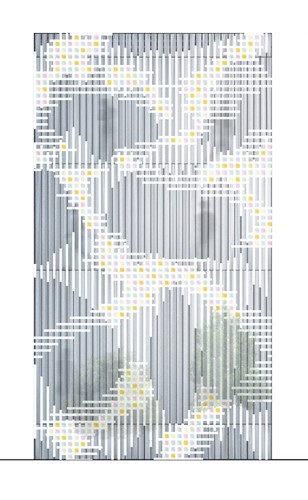
As a design student, my goal is to create spaces that foster connections among people, promoting tolerance through spontaneous interaction and making the world more inclusive and understanding. The concept driving the idea of this façade is the idea of a mosaic – which by definition, is the combination of diverse elements to form a cohesive whole. While differences remain visible and celebrated, they are ultimately integrated into a harmonious, unified design.
The façade features a dynamic interaction of horizontal and vertical members that outline the building’s floors. The vertical members delineate the floors, while the horizontal members are more scattered. The orientations represent differing perspectives and ideas, which at times are close to interacting, but do not quite reach each other. At their intersections however, vibrant, insulated glass blocks extend slightly outward, forming a striking mosaic effect. This both enhances the building's sculptural quality and also symbolizes the integration of diverse ideas and perspectives. The colored glass represents the beauty of sharing, collaborating, and interacting. The interior would have patches of colored light on the walls and floor, changing orientation depending on the time of day.